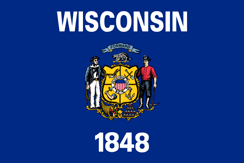
Wisconsin’s state flag is chock-full of meaning. Unfortunately much of it is a mystery to modern eyes. The flag was adopted in 1913, and over the past 100-plus years, many people no longer recognize what its symbols represent.
(This is the last of a series explaining the flag.)
During the mid-19th to the mid-20th century, Wisconsin workers and skilled laborers made the state a manufacturing powerhouse and celebrated it on the flag with an arm holding a hammer. Among the many parts and machines made in early Wisconsin were heavy machinery, tools, vehicles, farm implements and ships.
Farming has been a mainstay of the Wisconsin economy since its founding in 1848. Corn, dairy, poultry products and soybeans have long been major contributors. The flag honors these industries with an illustration of a plow.
Wisconsin soldiers weathered some of the Union’s highest casualty rates during the Civil War and the state was one of the most pro-abolition in the nation. More than half of the state’s 91,000 Union soldiers were registered voters. Twelve thousand Wisconsin soldiers, 13 percent, died in service to their country. The state recognizes their fidelity to the Union with a shield in the center of the flag with stars and stripes and the nation’s motto, E Pluribus Unum, “Out of many, one.”
The flag is set upon a blue background signifying loyalty. The year 1848 is noted because that was the year Wisconsin was welcomed to the Union. The word “Wisconsin” is emblazoned on the bottom of the flag to distinguish it from other state flags.
Finally, the flag represents hope for the future. A cornucopia stands for prosperity. This is signified by the word “Forward” in bold letters on the flag.
Wisconsin became one of the most influential states in the Union. Wisconsin public officials established direct primary elections, broke up business monopolies, preserved state forests, and defended small farmers. Important legislation included one of the nation’s first workers’ compensation programs, factory safety regulations, and limited work hours for women and children. State officials also initiated the Wisconsin park system.