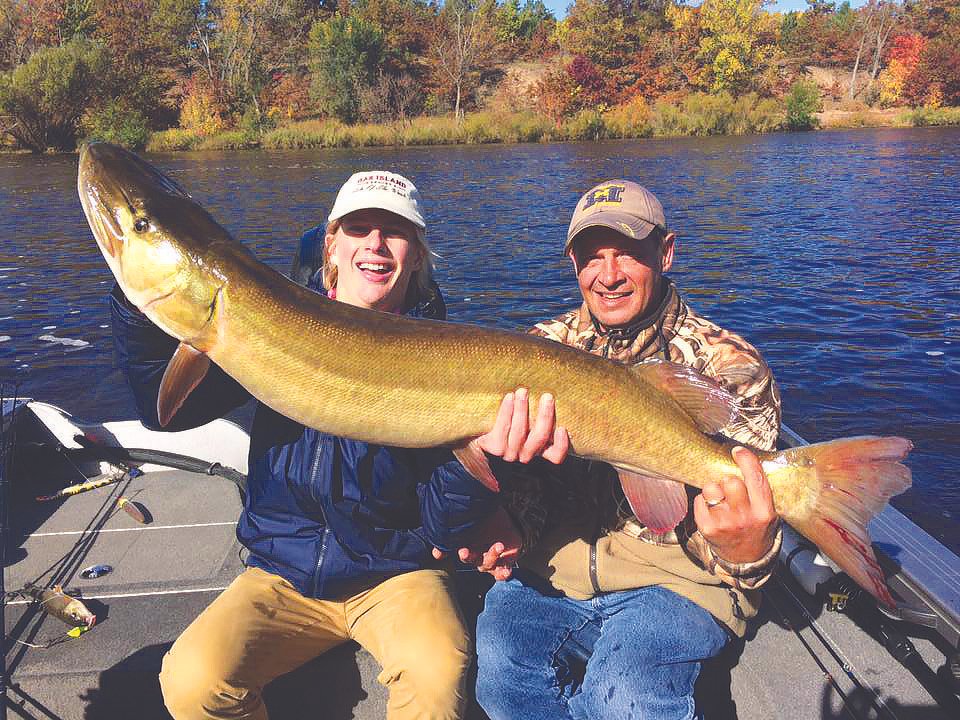
Autumn is among my preferred seasons for targeting muskies.
During this time, their behavior becomes more predictable and they
significantly increase their feeding activity. It is common to experience
multiple fish days, along with the chance of catching a true giant.
When pursuing muskies in the fall, I consider several factors. These include
the time of day I’m fishing, the water temperature and, if I’m fishing a river,
the flow rate and whether the water level is rising, falling, or remaining stable.
All these elements assist me in determining my approach for the day, where to
begin, and which lures to use.
My main focus is on shoreline structures; however, I also target deep river
channels, areas with current breaks, and slack-water regions adjacent to
the main current. I generally employ large, slow-moving lures such as glide
baits, crankbaits, and soft plastics. Additionally, I prefer to use live suckers
suspended beneath large slip-bobbers set at various distances from the boat.
Typically, I operate two setups, with one positioned about five feet behind
the boat and the other approximately 40 feet behind. Both live sucker rigs are
adjusted according to the depth of the water.
As winter approaches, muskies intensify their feeding, prompting me to
utilize larger baits such as Grandmas, Medusas, Bulldawgs, and Suick’s. Once
the water temperature drops below 50 degrees Fahrenheit, I begin to slow my
retrieval and occasionally pause, which mimics a dying fish scenario, allowing
the bait to remain suspended in the strike zone and sometimes enticing the
musky to strike with that additional time.
Lastly, it is crucial to closely monitor the flow rate. A swift current tends
to drive muskies towards the shoreline and into areas of slack water. This
scenario is ideal for fall muskies, as they prefer to avoid the struggle of both
current and cooler temperatures, making their locations more predictable.
In contrast, with a slower current, muskies tend to disperse and are not
compelled to congregate in specific slack water areas, necessitating a broader
search to locate active fish.
Implementing some of these recommendations, along with minor
adjustments to your presentation and focusing on particular locations, can
significantly influence your success, determining whether you return home
empty-handed or with the catch of a lifetime.