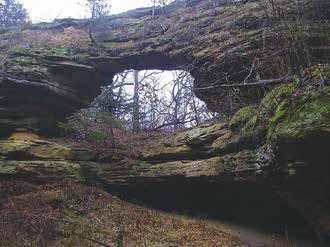
As an official state park, Natural Bridge’s history runs fairly shallow, only attaining the designation in 1973. But the 530-acre site’s overall storied lineage runs much deeper, into Wisconsin’s glacial periods, as noted by archeological studies and a popular natural feature.
One of Natural Bridge’s standout attributes as a state park is the natural arch – Wisconsin’s largest – which is alluded to in the green space’s name. The arch is the largest within Wisconsin and, over time, has attained widespread notoriety because of this distinction.
More than a full century before Natural Bridge’s creation as a state park, documented evidence indicated the unique arch became a tourist attraction, drawing people far and wide to the area to marvel at it.
According to the Wisconsin Department of Natural Resources’ website, there is documented evidence of an Independence Day celebration taking place at the arch in 1885. The site also notes an 1888 article from a then-local newspaper, the Sauk County News, noting the area was “visited nearly every day.”
An accompanying natural feature, the Raddatz Rockshelter, is situated directly beneath the arch. Archeological and historical data links the shelter back to the Paleo-Indian community that had settled in the area.